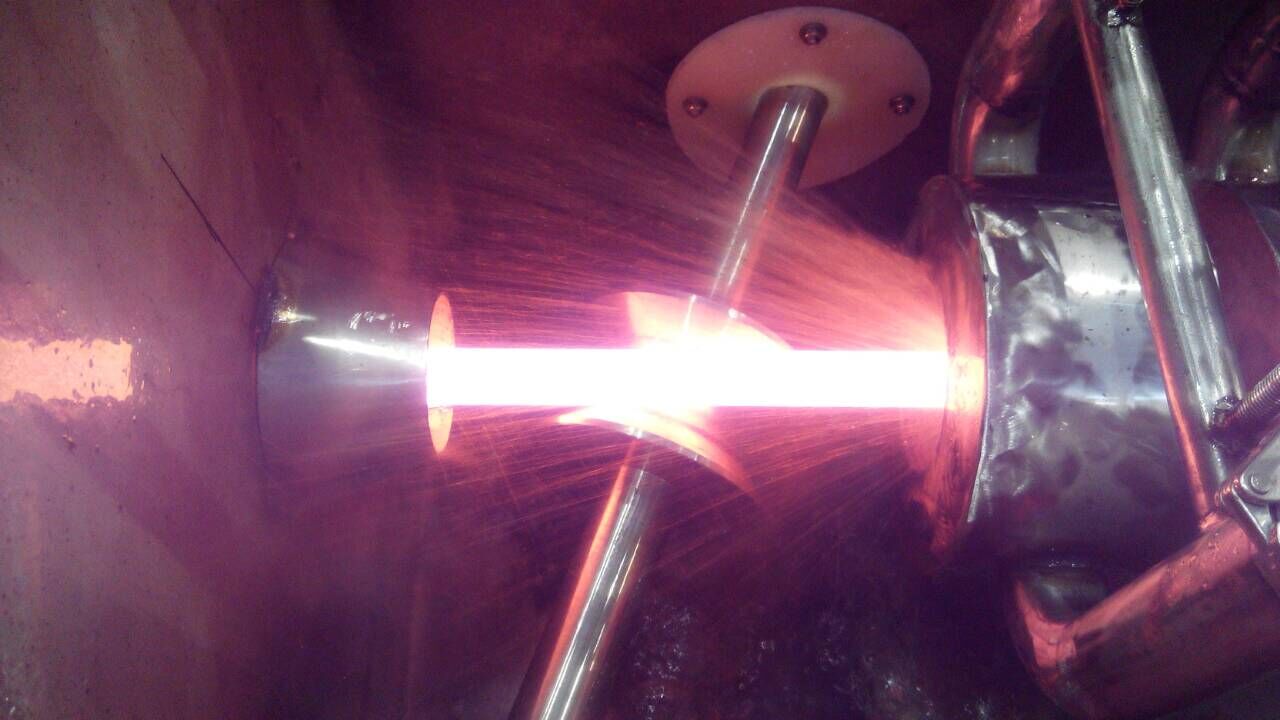

Quenching and tempering equipment for steel bars refers to a category of industrial machinery used in heat treatment processes to rapidly immerse metal workpieces-previously heated to the austenitizing temperature-into a cooling medium (such as quenching oil, water-based solutions, polymer solutions, molten salts, or high-pressure gas). This process induces a martensitic or bainitic phase transformation, thereby significantly enhancing the material's hardness, strength, wear resistance, and fatigue life.
Its core function is not merely to lower the temperature; rather, by precisely controlling cooling rates, temperature gradients, and medium flow dynamics, the equipment selectively regulates phase transformation kinetics at the microstructural level, enabling the workpiece to achieve the desired combination of mechanical properties and dimensional stability. In terms of structural composition, typical metal quenching equipment consists of a heating system (often integrated with a preceding furnace or configured independently), the quenching tank itself (featuring a corrosion-resistant lining and modules for sensing liquid levels and temperature), a medium circulation and temperature control system (comprising pump units, plate heat exchangers, refrigeration units, and PID intelligent temperature control units), workpiece transport and positioning mechanisms (such as overhead conveyors, pallet lifts, robotic grippers, or mesh belt systems), and a comprehensive automation control system (based on PLC+HMI or MES interfaces, supporting the storage, retrieval, and traceability of process parameters, as well as deviation alarms). Based on the cooling method, the equipment can be classified into oil, water, gas, salt bath, and vacuum high-pressure gas quenching systems. Operational modes include continuous (suitable for mass-produced standard parts like gears and bearing rings), batch/periodic (suitable for single items or small batches of irregularly shaped parts like molds and shafts), and flexible integrated lines (capable of mixed-flow production for workpieces of various materials and specifications). Modern high-end quenching equipment typically features independent multi-zone temperature control (allowing the tank to be divided into 3–5 temperature gradient zones), dynamic adjustment of medium flow velocity (programmable within the 0.1–2.5 m/s range), and real-time cooling curve fitting (supporting the mapping of Jominy end-quench data back to process parameters); furthermore, it deeply integrates digital twin technology to enable virtual quenching. Simulation and Physics
Closed-loop calibration of equipment operating parameters is essential. Regarding material compatibility, equipment designs must be tailored to specific metal systems: for carbon and low-alloy steels, the focus is on rapid, uniform cooling to suppress pearlite transformation; for high-alloy tool steels (e.g., H13, D2), a strategy balancing rapid cooling in high-temperature zones with slower cooling in low-temperature zones is required to mitigate cracking risks; for non-ferrous metals like aluminum and titanium alloys, success relies heavily on precise medium temperature control (±1°C accuracy) and oxidation-free environments (such as nitrogen-shielded gas quenching) to prevent surface dezincification or the formation of an alpha-case layer. Key performance indicators include temperature control precision (standard ±2°C, up to ±0.5°C for high-end models), cooling uniformity (temperature difference <5°C across the same cross-section), medium cleanliness maintenance (particulate levels